

The Vatican has expressed “shame and sorrow” over the sexual abuse of at least 1,000 children by more than 300 Catholic priests in Pennsylvania, and has said Pope Francis is “on the side” of survivors. The grand jury report, nearly 900 pages long, was the result of one of the largest US investigations into sexual abuse in the Catholic church. It detailed both the scale of abuse and the extraordinary lengths the church went to conceal and protect the perpetrators. “Victims should know that the pope is on their side. Those who have suffered are his priority, and the church wants to listen to them to root out this tragic horror that destroys the lives of the innocent.” The statement is part of fresh efforts by the Vatican to get on top of a wave of sexual abuse scandals and cover-ups. The pope was personally damaged by his denunciation in January of abuse survivors in Chile who drew his attention to cover-ups by senior figures in the church. Francis was later forced to apologise and launch an investigation which resulted in the resignation of five bishops. He will face further pressure on a papal visit to Ireland next weekend, when survivors of sexual abuse will demand he take institutional responsibility for the church’s failures. Read the full article: https://www.theguardian.com/world/2018/aug/16/vatican-pennsylvania-sex-abuse-scandal-children-pope-response
New Kentucky Law Strives to Aid Neglected and/or Abused Childre
The author states a Kentucky law has “good intentions” but is burdensome for school districts around the state because the law requires child abuse and neglect background checks of public school personnel, student teachers, contractors, and parents on school based decision making councils. A letter from the Kentucky Cabinet for Health and Family Services, which is responsible for processing the checks, is required to verify a check has been completed. Prior to the new law, criminal background checks were required for all school system employees and school volunteers. Now, the background checks include a state social worker’s substantiation of child abuse or neglect. Although some may consider this law to be an unnecessary headache, it may just be the extra step needed to find and help hurt children in need of aid. https://www.google.com/amp/amp.kentucky.com/news/local/education/article215775035.html
Art 4 A Purpose
A shout out to Art 4 A Purpose, a similar organization like us. empowering children and their communities to recognize child abuse and get help through art. Art 4 a Purpose invites the community to view its annual Cake Decorating, Coloring and Art Contest on display at CoMMA through Thursday, June 28. The organization is using the event to further its mission of using the arts to raise awareness of child abuse. Artists, photographers, writers and coloring artists from across Burke County, NC have submitted works that seek to educate the public of the trauma of child abuse and the need for preventative efforts. The exhibit can be viewed anytime during CoMMA’s regular business hours. CoMMA is located at 401 S. College St. in Morganton, NC and can be reached at 828-433-7469. Art 4 a Purpose is located at 3522 Baptist Camp Road in Connelly Springs NC and can be reached at Art4aPurpose@gmail.com or 828-475-2881. For more information, visit www.Art4aPurpose.org . Read the full article here: http://www.morganton.com/gallery/art-a-purpose-cake-decorating-coloring-and-art-contest/collection_2496dc1a-6ff9-11e8-af7f-13f04cac116a.html#3
Law Enacted in NY Town to Curb Bullying
Around a quarter to a third of American students have said they’re bullied at school, according to the U.S. Department of Health and Human Services. A main problem with this is many parents and guardians are unsure how to respond to bullying incidents—regardless of whether their kids are the victims or the perpetrators. North Tonawanda, a town located in western New York, instated a new rule on October 1 that allows parents to be fined $250 or be sentenced to 15 days in jail if their child violates city laws two or more times within a 90-day span. City laws include rules against breaking curfew and bullying, which means parents in North Tonawanda can now go to jail for their kid’s cruel behavior in school. “We hope to never need to use this law but it’s there in extreme cases,” Greg Woytila, superintendent of North Tonawanda’s city school district, told ABC News. “But we need to do a better job and we are continually trying to do that.” Whether or not you live in North Tonawanda, bullying is a topic that needs to be discussed. If you are unsure if your child is a bully or being bullied, look for signs that they may be lashing out at others or seeking affirmation—then work to correct that behavior, seeking outside support if you need it. Read full article: https://www.simplemost.com/law-says-parents-could-go-jail-kids-bullying/
What Is Medical Child Abuse?
A New York Times Opinion piece from 2011 dives into this important, but not wildly covered, issue. The term “medical child abuse” dates from the mid-1990s, as a condition related to Munchausen syndrome by proxy, a mental disturbance in which a parent induces illness in a child to get attention. It has caught on with doctors over the last decade. But what constitutes “unnecessary medical care” — the heart of the test for medical child abuse — is vague and subjective. After all, doctors often disagree with one another when it comes to the diagnosis and treatment of complicated conditions. FEW things are tougher for a parent than dealing with a child’s serious medical condition, particularly if it is complicated and hard to diagnose. The parent has to make hard choices about treatment, navigating conflicting advice from doctors or even rejecting one doctor’s opinion and seeking another. Recently, the situation of these parents has gotten even harder. Some doctors and hospitals have begun to level a radical new charge — “medical child abuse” — against parents who, they say, get unnecessary or excessive treatment for their kids. That this care is usually ordered by other doctors hasn’t protected parents from these loaded accusations. Although most of these cases have nothing to do with real child abuse, credulous child welfare officials have too often supported the doctors, threatened parents with loss of custody, and even removed kids from their homes — simply because the parents disagreed with the doctor’s plan of care. Read more: https://www.nytimes.com/2015/07/12/opinion/sunday/the-new-child-abuse-panic.html
Hands Off!!
I was abused by a priest beginning at age 5. Raped and impregnated by same priest while still in elementary school. Miscarried. Lost the baby, my innocence and my childhood. Endured several surgical procedures while still in elementary school and continuing throughout my first year of high school. Final result…a total hysterectomy. No children for me ever. I would forever carry that undeniable void. It is a life long pain, a loss that I grieve daily. Mother kept ‘my secret’? My ‘dirty little secret’? To this day I still do not know what my siblings were told about ‘my dirty little secret’. I do not know what my own father was told. The Silence was Deafening. At 15….a nun enters my life. She was 36. A nun paid attention to me! A nun. A holy woman. A woman of God. My whole young life all I wanted was to be a nun. I wanted to be holy. For a young catholic girl in the 60’s…this was a dream come true. She paid attention to me! She listened to me. She told me I was smart and interesting and pretty. She seemed to care. She told me she cared. She told me she loved me. She sent me love letters. She warned me not to show them to anyone. I did not understand. I hid them but I wanted to shout it to the world. I kept those love letters as a teenager would forever hold onto the remnants of their first crush. Sister Pedophile was my first crush. She proceeded to teach me about sex. 15/36. Fifteen! Thirty six! She groomed me. I told her about the priest and the rape and the miscarriage. She told me, “he was a sick man and it wasn’t his fault” and then she took me under her wing and into her bed. She gave me Librium and Valium. She gave me gifts… and time. She fed me alcohol. She drugged me to make me more compliant in the bedroom. I was scared. I was naive. I was virginal in this aspect. She told me the pills would help to relax me. Her needs often exceeded the bedroom. She demanded attention in obscure places; the back seat of the convent car, dark balcony seats in movie theatres, elevators in NYC, her relatives homes, a friend’s swimming pool, her parent’s own bed, and highway motels on Route 17 in Bergen County, New Jersey…in the middle of the school day… 20 minutes from my parent’s home. She took me out of class in my catholic high school. She was a nun. She was a school Principal. No one stopped her. She took me to the Meadowlands and taught me how to bet on the horses. I was 15 and 16. She introduced me to the lights and excitement of Atlantic City and extravengant hotel rooms where we would stay behind closed doors for entire weekends. Enjoying yummy fluffy snuggly bath robes, 24 hour room service, a bar in the room, huge soft clean beds with crisp white pressed sheets and a million pillows, AND… a Privacy tag that hung on the outside knob of our bedroom door. How could I not thank her? She offered me the world and asked only for my body. With an ocean view, this is where she taught me how to please her. She always wore a medal of the Virgin Mary during sexual encounters… and sometimes her veil and ring. I still have the veil. It was confusing. She took advantage of my age and natural desire to please and to be liked. She abused me. She used me emotionally, mentally, physically and sexually. She destroyed me Spiritually. She toyed with my young feelings. She promised, cajoled, pressured and lied to me. She stole my Innocene, my Future and my Faith. She broke me while at the same time telling me she was my Savior…saving me from a dysfunctional family. She put a wedge between me and my family. I lost my siblings, parents, cousins, aunts and uncles. But worst was the loss of my niece and nephews. She told me I could not date boys. She told me how to wear my hair and who I could hang out with. She isolated me. She destroyed me for her own sexual gratification. I was her toy girl. (But, according to her belief regarding the pedophile priest… it wasn’t her fault… she was a sick woman?) But it was very much her fault. I was still a kid. It was the Stockholm Syndrome for me. I was so emeshed with her…I would have died for her. She did an exemplary job at grooming. No doubt she had prior experience. She was polished at the Art of Teen Grooming. She was accomplished. (Practice makes Perfect) I was most definitely not the first notch on the belt of the rosary beads that circled her waist. She was practiced and crafty, manipulative and sneaky. She isolated me from my friends and family. No one intervened. Her ‘religious congregation’ knew, yet did nothing to curb her perverted appetite. She took me into convents up and down the east coast of the United States and across International borders into Canada. We drove from Florida to Nova Scotia and back to New Jersey several times over the span of 12 years. I slept in convents and motels up and down the east coast. (I could write a book on the things I saw and heard.) Always entering the convents through the backdoor and up the back staircase to the second floor… passing others nuns who would literally turn their backs as I entered, (blind eye deaf ear defense) and again as I exited the next morning. I was ripe for the picking. The Pedophile Priest had prepped me well. Over the years, I sought out four nuns in her community and begged them, through my tears to make her stop. I read them a heartbreaking letter
Pennsylvania Family Support Alliance: Another Resource Protecting Children From Abuse
April is Child Abuse National Prevention Month. During April, Pennsylvania Family Support Alliance (PFSA) undertakes a multi-tiered effort to encourage Pennsylvanians to get a clearer picture of the tragedy of child abuse and what role they can play in preventing it. PFSA believes that every citizen in Pennsylvania has a vital role to play in protecting our children. This center is designed to help you do just that! It’s a complex problem and the child welfare system is also complicated. They want to help you understand the issues, communicate with key legislative leaders and use your voice to ensure the safety of our most precious state resource – our children. PFSA has been honored to work with members of the Task Force on Child Protection, the House Children and Youth Committee, the Senate Aging and Youth Committee and members of PA’s General Assembly to strengthen our Child Protective Services Law and advance efforts to keep PA’s children safe from child abuse. It has been an extraordinary time and the changes made will spare countless children from immeasurable harm. It has been a time of walking the talk and putting the safety of children above the convenience of individuals, institutions and organizations. We applaud the efforts of everyone who played a role in these changes; changes that collectively are steps toward changing our state’s culture toward how children are valued. On average, more than 30 children die in Pennsylvania each year as a result of child abuse, most at the hands of a parent who gave them life. We need your help to turn this around; we simply can’t sit by when the equivalent of one elementary school classroom of children are killed annually. Join us in the fight to protect PA’s kids – they need you and so do we! PFSA also work with legislators to bring their prevention message to citizens in their legislative districts. They recently met with constituents of State Rep. Kathy Watson in her Bucks County district to discuss changes to the CPSL, background checks and clearances and their community-based prevention program, the Front Porch Project. They help shape, move and improve public policies to protect our kids. They’re a visible presence on Capitol Hill, leading the charge on laws requiring mandated reporter training and comprehensive background checks for educators, and championing PA’s long-needed package of bills revamping our state’s child protection laws. Learn about their history of championing improved protection for children, current policy debates and legislative initiatives: http://www.pa-fsa.org/Prevention-Month
Take Back The Night!
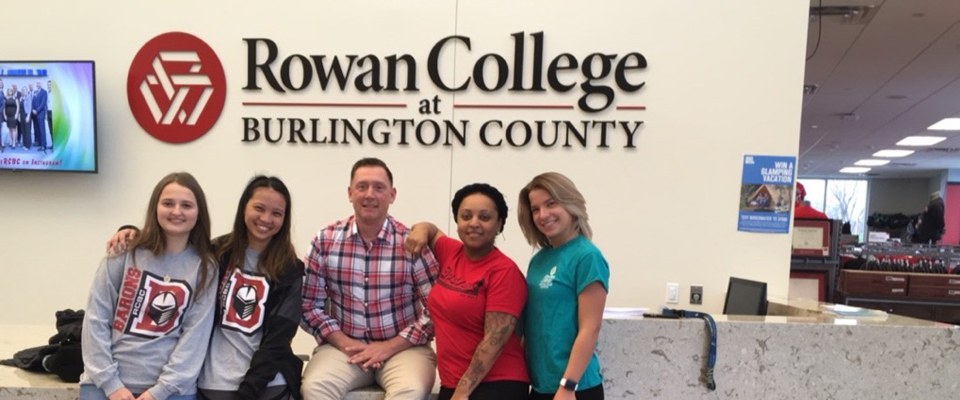
The Humanity Preservation Foundation (HPF) was honored to speak at Rowan College Burlington County‘s “Take Back the Night” event. This took place on Tuesday April 24, 2018. The event was coordinated by the “Service Learning Students” (pictured). At Take Back the Night, president/co-founder of HPF, Rhett Hackett, spoke to a group of students and faculty. He told his personal story of child sexual abuse, his appearance on the Oprah Winfrey Show, and consequently the launch of Humanity Preservation Foundation. His presentation included the topic of their recent campaign “HandsOFF” as well as the launch of their victim support project “PULSE.” PULSE app is available for download on android devices. Afterwards, Mr. Hackett participated in the “walk” around campus which is part of the Take Back the Night tradition. This walk represents a promise made by students and faculty that sexual violence isn’t going to be tolerated on college campuses. It encourages victims of sexual abuse to report it, speak up, and know that you are not alone. With the launch of their HandsOFF campaign, HPF has committed time to implementing awareness and resources across colleges and universities. HPF acknowledges that with so many acts of sexual and domestic violence happening at the college level, it is important that everyone does all they can to minimize the number of events. It is also important to understand the impact abuse has on those victimized. Additionally, Mr. Hackett stated that working with this age group, the next group to have children and become parents, will encourage them parenting differently then previous generations. In order to stop sexual and domestic abuse in future generations, we must start now with today’s youth. Learn more about Take Back the Night: https://en.wikipedia.org/wiki/Take_Back_the_Night_(organization)
How Is Vermont Protecting Your Children
Teresa is an advocate for Prevent Child Abuse Vermont, and a child abuse victim herself. It’s been almost 30 years since she moved to Vermont and away from a life she swore she’d leave behind. “There was a lot of physical and sexual abuse, all in relation to my surroundings,” says Teresa. “There was probably between 7 and 10 abuse cases that I went through…stepfather, uncle, neighbors, friends of friends.” Teresa teaches the nurturing program, offered through Prevent Child Abuse Vermont, an advocacy group geared towards stopping child abuse before it happens. “It teaches parents empathy and learning from past behaviors and how to change them.” It’s one resource you can turn to if you know of a potential child abuse, or neglect case. Reports in Vermont are going up. Data shows since 2014, 50% of children from birth to five years old came into state custody due to opioid abuse in their families. Teresa says the work is far from over to make sure another child doesn’t become another statistic. “They need to have more people listening to their stories and helping them out and not just giving them a number.” Read more of this article here: http://www.mychamplainvalley.com/news/child-abuse-prevention-month-how-is-vermont-protecting-your-kids/1146109353
HPF Heroes – Anonymous 6
I’m a survivor of childhood sexual abuse and incest. I had a very traumatic childhood. I was born hearing impaired. Had 10 surgeries from 6-10 on my ears. Raped at 7 by a 17 yr old cousin. Issues with my moms first husband under the age of 2, not knowing the full extent of abuse from him. But a lot of trauma. At the age of 9 he came to visit, he French kissed me with alcohol and cigarette smoke on his breath. The smell of old spice all together, are triggers for me. Hate the smells. Also, he tried to kidnap me from school on several occasions, but was unsuccessful. While pursuing my life dream career as a police officer, I saw his name in the detectives office. As the the top of the list on the board for most dangerous person in Ontario. He was a biker, and a mean one. I was terrified they’d find out I was his bio daughter. I later found out he wasn’t my bio dad. I always felt I was the child of Satan. Great thing about growing up in a small town, lots of friends and life long ties. I was adopted at 2.5 by an amazing man, he was my rock. 2 of the 4 marriages my mom had were to very good men. Thank God, I married a good man. He is a little of both of them. My children are so blessed, to have not known about abuse personally. My house burned down twice as a child. I was emotionally and physically abused by my mother all of my childhood. She was an alcoholic. When I was in my teens, I drank and partied with friends. I was raped while passed out. When I was 26, I was hit head on by a drunk driver while I was In college for nursing. My mom had completed her first yr of sobriety, and was attending the family program. I was told, I may never walk again on my left foot. I was walking in 9 months. Stubborn like my mom. When I had my first child at 27. I looked at my husband, and said I remembered my rape at 7. But I was so happy to have my son. Life changed me. Everything was amazing. Love healed me. Then I had my second daughter, Doctor didn’t catch her at birth. She had a severe neck injury. She lived for 64 days. Losing her was losing my childhood all over again. But I got pregnant and a yr later I had my 3rd child. A girl. My mom held my Michaela while she died, and delivered Chelsea-Michaela. Then 4 months later, I found my moms daughter, my sister, my mom gave up for adoption. My mom got pregnant at 14, against her will. When my mom went to rehab, I forgave her for everything. She deserved to be in her grandchildren a lives. Forgiveness was a gift I gave to myself. I’ve spent the last 20 yrs growing up with my children, loving every minute. When my children were 1 and 4, I got a settlement from my accident. I used it to start my charity, at the time it was called “Save The Children, Stop Sexual Abuse”. 4 yrs into my charity, I was sued by Save The Children International and Canadian. They were afraid someone would donate to the wrong charity. And a lawyer from MBM Law Firm in Ottawa called and represented me pro bono. I had to change my name. Secrets “Protect Our Children, Stop Sexual Abuse” it would be. 2018, I’m in my 17th yr. and I’m inspired everyday by amazing heroes and Sheroes. Life is crazy beautiful. Education, prevention, raising awareness, empowerment, and promoting healing is our goals. I love my life, and helping others, helped me to heal from my childhood and trauma. Today, I help victims anyway I can. I pray a lot. And I love my children. Everyone has a story. By sharing, we empower others. We are not alone. There is no shame in your story. Please share it, to inspire others 💓 Love